

Oyster Sauce 101: All Types of Oyster Sauce Explained
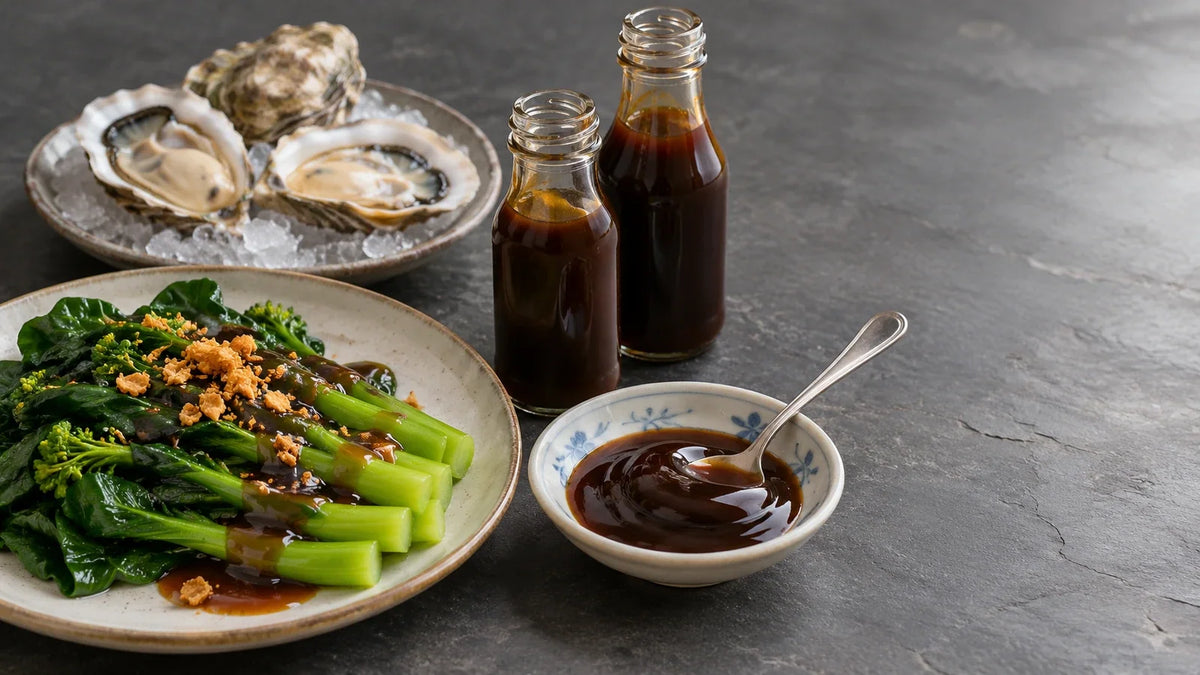
There are few bottles that go over the counter as often as oyster sauce. In our grandpa's shop in Suriname, the jars were always next to the soy sauce, and even now, it is the sauce our customers in Amsterdam ask for when they want to make a wok dish that tastes like it came from a Cantonese restaurant. But which bottle should you choose, what is the difference between Premium and Panda, and what should you get if you don't eat shellfish or gluten? In this guide, we lay it all out for you. The bottles in our toko are the same ones you'll find in supermarkets in Hong Kong and Bangkok, from Lee Kum Kee to Megachef and Maekrua. If oyster sauce belongs in a larger pantry, check out our pillar Chinese cuisine 101.
What is oyster sauce?
Oyster sauce (蚝油, hou yau in Cantonese) is a thick, dark brown sauce made from oyster extract, with a rounded, savory, and slightly sweet flavor. The extract is made by letting oysters steep for a long time and reducing the liquid; then sugar and salt are added, and most brands also add starch to give the sauce its syrupy thickness. It barely tastes like fish; you mainly taste depth, the kind of savory flavor we call umami.
The sauce comes from Cantonese cuisine in southern China. According to legend, Lee Kam Sheung, the founder of Lee Kum Kee, discovered it in 1888 when he accidentally overcooked a pan of oysters, leaving behind a thick, brown, and surprisingly delicious sauce. Today, oyster sauce is just as much a staple of Thai, Vietnamese, and Malaysian cuisine, and it is also indispensable in Surinamese-Chinese cooking.
What types of oyster sauce are there?
Roughly speaking, there are four types: rich Chinese oyster sauce, milder Chinese oyster sauce for everyday use, Thai oyster sauce, and gluten-free or oyster-free varieties. Below you can see them side by side, and underneath you can read what sets them apart.
 Lee Kum Kee PremiumFull-bodied and rounded, for sauces that are allowed to taste like oysters
 Lee Kum Kee PandaMilder and more affordable, for marinades and everyday wok cooking
 Lee Kum Kee gluten-freeCantonese flavor, made without wheat
 Dek Som Boon gluten-freeThe Thai gluten-free choice
 Megachef PremiumThai, made with broth from real oysters and without added colorings or flavorings, and also available as a small 240 ml bottle
 MaekruaA trusted name in Thai kitchens, also available in a 150 ml bottle
 Dek Som BoonBetter known to many as Healthy Boy
 Lee Kum Kee veganPlant-based, with the same shine in the wok
 Megachef veganMade from smoked shiitake, giving it a slightly smoky note; it is also available in a larger bottle.
Lee Kum Kee Premium and Panda

Thai oyster sauce

Gluten-free oyster sauce

Vegan and vegetarian oyster sauce

Which oyster sauce should you choose?
Choose oyster sauce according to the cuisine you are cooking and the role the sauce plays in the dish. If oyster sauce takes center stage, such as in choi sam with oyster sauce or beef in oyster sauce, take Lee Kum Kee Premium. If a spoonful goes into a marinade or a sauce with many other flavors, Panda does the job perfectly. For Thai dishes, take Megachef, Maekrua, or Dek Som Boon, and those who don't eat gluten or animal products choose one of the gluten-free or vegan bottles above.
Not sure? Then start with a 255-gram bottle of Lee Kum Kee Premium. With that you can cook all the Cantonese classics, you immediately taste what good oyster sauce does, and the bottle is finished before it has had its best time.
You can find the entire range in our oyster sauce collection, and the rest of the Chinese and Thai bottles are under Chinese sauces and flavorings and Thai sauces and flavorings.
Cooking with oyster sauce
You mainly use oyster sauce in the wok, over vegetables, in marinades, and as a glaze, and almost always together with soy sauce. A few things help you get the most out of it.
In the wok
Because oyster sauce contains sugar, it can quickly burn on high heat, and therefore you add it only towards the end, when the meat and vegetables are already almost cooked. The easiest way is to mix a sauce beforehand of oyster sauce, a dash of light soy sauce, some water, and a teaspoon of cornstarch, so that you can pour it all at once along the edge of the hot wok and it pulls together into a shiny layer around everything within half a minute. A dash of Shaoxing wine and a few drops of sesame oil at the end make it complete.
Over vegetables
The simplest way to get to know oyster sauce is over green vegetables. Briefly blanch choi sam, kailan, pak choi, or broccoli in water with a pinch of salt, let them drain well, and pour a warm sauce over them made of oyster sauce, garlic, a little sugar, and water, optionally thickened with some cornstarch.
In marinades
In a marinade, oyster sauce provides depth and a beautiful brown color. A spoonful of oyster sauce with some light soy sauce, Shaoxing wine, and cornstarch is enough to make thin strips of meat, for example bavette or pork tenderloin, tender and savory in fifteen minutes. Also in the filling of siu mai and with steamed ribs, a spoonful of oyster sauce gives just a bit more depth.
As a glaze
Mix oyster sauce with honey or some brown sugar, a little soy sauce, and optionally hoisin sauce, and you have a glaze for chicken wings, spareribs, or roasted vegetables from the oven or the barbecue. Apply the glaze only in the last few minutes and keep a close eye on it, because due to the sugar it quickly turns from beautifully dark to burnt.
Recipes with oyster sauce
These Cantonese recipes show well what oyster sauce can do, from a quick vegetable to a full wok with noodles.


More with oyster sauce? Try the Cantonese fried egg noodles with beef, or cook Thai with pad krapow and pad see ew, in which a Thai oyster sauce really shines.
How do you store oyster sauce?
Store a closed bottle of oyster sauce cool and dry in the cupboard, and after opening, put it in the refrigerator, as most manufacturers indicate on the label. Use a clean spoon, close the cap tightly after use and wipe the neck of the bottle, so that no crust forms. How long an opened bottle stays good varies by brand, so follow the label. If you notice an unusual smell or mold, throw the sauce away.
Frequently asked questions
Does oyster sauce taste like fish?
Hardly. Good oyster sauce tastes mainly savory, round and slightly sweet; the oyster flavor itself is subtle and disappears in a dish among the other flavors.
What is the difference between Lee Kum Kee Premium and Panda?
Premium contains more oyster extract and tastes fuller, and is therefore the best choice when the sauce takes center stage. Panda is milder and more affordable, and suitable for marinades and stir-fries.
Is oyster sauce gluten-free?
Usually not, because most oyster sauces contain wheat. Choose a gluten-free version, such as those from Lee Kum Kee or Dek Som Boon, and always check the label.
What can you replace oyster sauce with?
A plant-based oyster sauce made from shiitake comes closest. If you don't have one, mix light soy sauce with a little sugar and some cornstarch; that gives you binding and salt, but lacks the depth.
Does oyster sauce need to be in the refrigerator?
Yes, after opening. As long as the bottle is closed, it can just sit in the cupboard.
What do you use oyster sauce for?
You use oyster sauce in wok dishes, over steamed or stir-fried vegetables, in marinades and as a glaze for meat. It gives a round, savory flavor and a glossy layer.
Is there a vegetarian oyster sauce?
Yes. There are plant-based versions made from mushrooms, such as the Vegan Oyster Flavoured Sauce from Lee Kum Kee and the Premium Vegan Oyster Sauce from Megachef. You use them in the same way as regular oyster sauce.
Oyster sauce is one of those bottles you don't really think about until you miss it once, and then you only realize how much a single spoonful does for a plate of vegetables or a quick stir-fry with beef. Start with one bottle, cook a few of the recipes above and feel free to taste a Cantonese and a Thai oyster sauce side by side, because then you'll naturally learn which flavor suits your kitchen. If you want to go further, you'll find the rest of the basics in Chinese cuisine 101, and if you come into our store in Amsterdam, we'll be happy to help you choose the bottle that suits your dish.

